Showing posts with label World Wide Web. Show all posts

Saturday, March 2, 2013

The server side... and ASP.net side...

Browsing through my draft posts I found this draft, which I wrote while I was still a PhD student... just some ramblings about web programming and my past experiences with it.

Stay in Touch

To my surprise I made a rather interesting observation as a PhD student. A number of my PhD colleagues actually do not have any web-based programming knowledge or experience. This might come as a surprise but it may be their university simply stressed more fundamental CS issues and there was little time left for web programming or maybe they simply never had a chance to gain significant on-course / industry practice in web programming, and once their PhD started, their PhD topic was concerned with an entirely different topic. Whatever the reason, there's not any justifiable excuse in these days to ignore server side languages, especially as a comp. science student. During my PhD I therefore challenged myself to stay on top of new technology in server side programming. And yes maybe I lost some time that I could have dedicated elsewhere, at least I am ready to build a web based system at any time in pretty much any server language you'd throw at me!

Arguments for & against...

Within web-programming, we have a choice of languages to work with: Perl or C++ within a CGI setting, or PHP, ASP.Net (C#), JSP (Java), to name a few. i dabbed around in all of them at some point, but the most significant 'competition definitely takes place between PHP & ASP.net

The choice of language more often than anything depends on the background of the programmer. Then come into play execution speed, client preferences (sometime these are more important than any other factors, but more about that maybe in another post), and quite important is the question of available support and the availability of code base from past projects or from 3rd party sources, whether these be open-source or commercial. But the main idea is that we don't begin development from ground level.

PHP has it all, clients like it because it sprang from the open source movement and much more codebase out there is open source than probably for any other server side language out there. So this covers the client preference & availability of code-base factors. The speed is generally acceptable and programmers generally love PHP and since it is an interpreted language it's very easy to maintain and the symbiosis between PHP & MySQL works extremely well.

When I first dabbed in asp.net, this was in 2003/04, on 1.1 and 2.0 of the .net framework. Compared to PHP I hated many things about it, but that's a longer story! Since those days Microsoft engineers were bussy developing the technology, and currently we are at framework 4.0. I heard a lot of hype, as tends to be with Microsoft releases, so I decided to tame my curiosity.
  • ASP.net web-forms
  • ASP.net MVC
  • Stripped down (web-form free) approach
The idea for the stripped down approach was always within my head but in order to take this approach you really had to feel comfortable with some complexities of the chunky asp.net web-forms approach, until I found Chris Taylor's article.
ASP.net is much more complex as PHP, and maybe this is the problem with asp.net too. Due to it's complexity and the learning curve porgammers, quite rightly, keep away from it. Just to name a few problems. The asp.net menu control would render very ugly (non standard comliant) XHTML mark-up, instead of a CSS styled list which would be the way to go here, or asp.net would generate client IDs that depended on where in the page the server control occured rather than keeping the server ID assigned to the control in the first place. Fortunately at least the above named issues are resolved with framewrok 4.0, which gives us 'hope' for Microsoft.

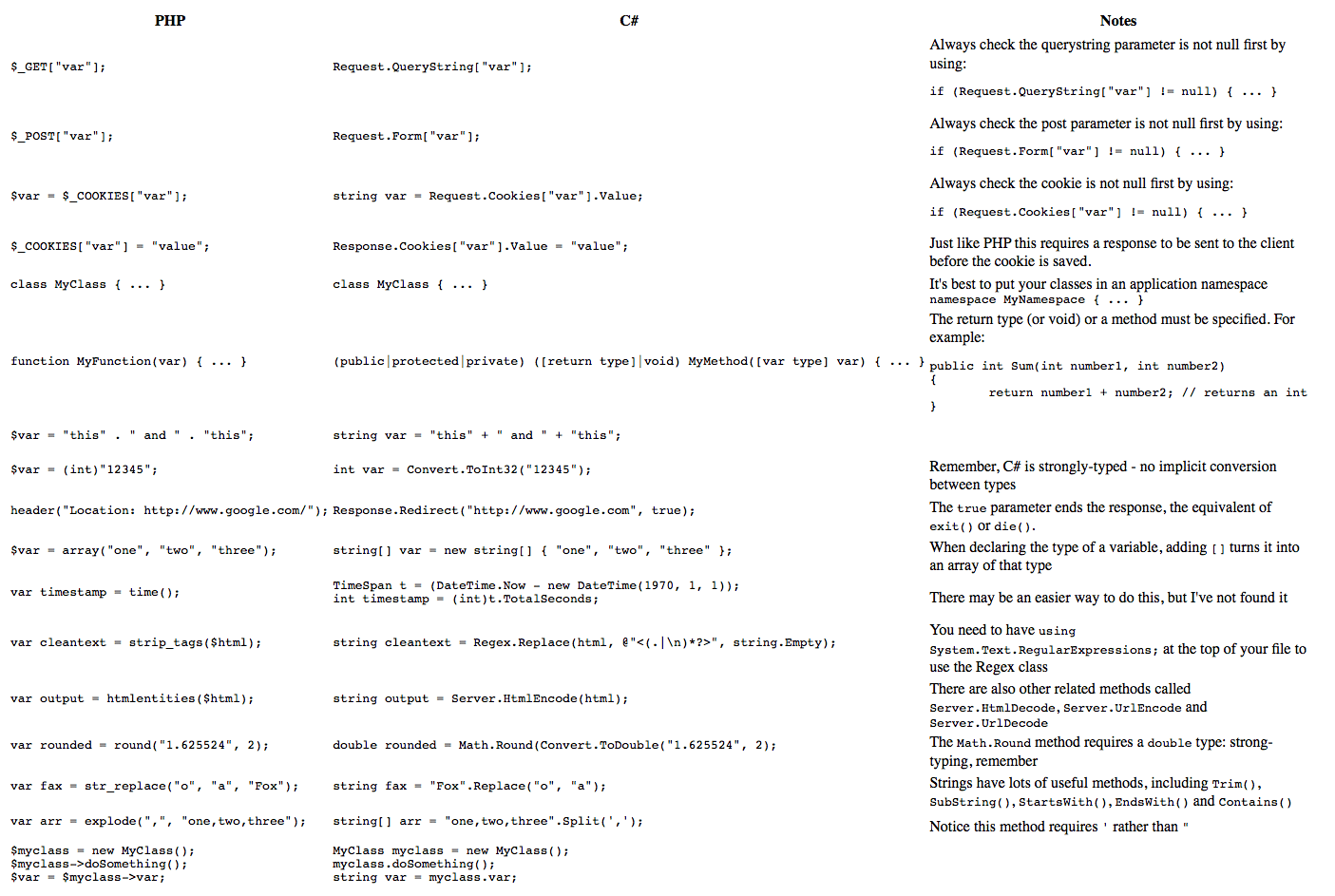
Comparison Table (useful for 1st time asp.net people)
Speed Comparison of server-side languages - check out the source site


Monday, October 4, 2010

Social Media Monitoring

WARNING: This article is critical of the Loughborough University Enterprise Office (an initiative to help commercials ideas & work from academia into viable business oportunities).

Well over a year ago (back in 2009, actually the idea came in 2008) I entertained myself with the idea of starting up a social media monitoring business. I have worked on the topic within my PhD and I have published on the topic and also did some decent work with a student of mine back through 2008/2009 academic year. Our results were great, winning me an IEEE best PhD student paper award at a conference among some encouraging feedback from my paper reviewers.

The idea was to use my student's existing server infrastructure (he runs a web hosting service in Poland) to accumulate web 2.0 datasets and apply data-mining and statistical techniques summarisation, and finally to build a nice and fancy User Interface based on edgy web-design techniques (which I lectured about to my large Introduction to Web Programming undergraduate class last year) and further wrap it all up into ontologies to be usable by semantic web capable agents!

The above sounded like a decent Business Plan to me, with relatively low risk, as I could have done this part time (aligned with the PhD) and we could have just used, as mentioned, my students server infrastructure to a degree. See this article for a very timely overview of Social Media Monitoring tools, and how significant they have become in business (There is much more academic work, looking at many case studies - drop me a line if you want some references to those).

We therefore decided to seek some initial funding or at least support from Loughborough's student enterprise office, in one form or another and depending on their response we wanted to begin development of the initial prototypes! After a few email exchanges and several phone conversations, I was very dissapointed...

The ent. office consultant was obviously overworked, and complained about her high volume of meetings, business trips and other responsibilities. Once I mentioned that we have published and received an award, her reaction shocked me. Apparently since the work was published we could not patent it, and hence without any possibilities of patenting she lost any interest. I was shocked by this reaction, assuming that patents still rule the world of software is something I consider quite ridiculous (just like the once click amazon buy button patent), in my opinion a barrier to innovation that's what my whole experience dealing with the entr. office at loughborough felt like.

It is ironic that reading the BBC article today, I realise that with a little bit support we could have had a finished beta product by today, covering local demand in social media monitoring in the Midlands area. Great way to throw logs under the feet of young university talent, Loughborough Student Enterprise Office, well done ;-)!

Any comments are welcome, at same time, I do know the Office was behind a few interesting projects, however they have a lot of improvement ahead to become worthy for a university of Loughboroughs Profile!

Friday, September 24, 2010

iReporter on CNN

Since web 2.0 largely concerns itself with easy data sharing, naturally it has already found many interesting applications within Journalism. One such example is CNN iReport, a web 2.0 system allowing any user to submit and edit news stories within a community of “citizen reporters”. Essentially any news can be uploaded since the contributions are neither edited, nor fact-checked, or screened, a-priori. Certain (urgent or timely) stories do get vetted and cleared by CNN, and these would be subsequently used by CNN in its mainstream broadcasting.

iReport is defined by a distinctive news-friendly community, which seems to find pleasure in reporting news. The community of contributors consists of around 20'000 enthusiasts who get ranked based on their site activity and value of contributions. Clearly the chance of an iReport item being selected by CNN for broadcast acts as a strong motivation itself (31'800 out of 485'000 reports were vetted by CNN, to date). See http://ireport.cnn.com/ and http://ireport.cnn.com/faq.jspa for more information.

Saturday, July 31, 2010

The Dot-com boom is over

The year 2000 was the infamous end of the dot-com internet boom; the 10th March to be precise! The period preceding this event saw heavy prefix investing (basically any company with an e- prefixed or .com appended to it was bought up straight away). This occurred because the expectation of promise from the internet and the future potential seemed enormous with the reach and potential of world wide web. However the technology and economical momentum simply was not there and thats why most companies failed.

The consolidation and second wave in what can be termed to be the second internet boom is the web 2.0 craze that is occurring at the moment: twitter, facebook, blogger, youtube, google, yahoo, ... The difference this time is that the technology has reached the tipping point. Economically online advertising now accounts for over $20 Billion worth in industry. A whole set of industry has grown around building and managing the huge datasets and data processing requirements of web 2.0 - this in turn is now supported by real profits of .com companies - and this is where the major difference to the previous boom. The simples business model - online advertising - actually works, online shopping works and finally some very cool new business models such as localised group buying emerged. Reasons: other than the technological advances and standardisation, the consumer trust issue has completely changed.

In my next posts, I intend to discuss web 2.0 criticisms and what they mean. I also intend to write several blog posts about the wayback machine! Any comments, please email or comment, thanks.

Wednesday, October 21, 2009

Large Search-Querry datasets

On a blog I recently visited, it was pointed out in context of a web search analysis study that: "This study also highlights the current situation in web-scale research: that only companies like Microsoft, Google or Yahoo! have access to the sheer volume of data needed to do such an analaysis." (sorry I do not remember the source of this, if it is ur blog please let me know, so I can reference you) This has been brought up numerous times in the past and I couldnt agree more. What is really very important is for society (/ internet users) to realise that they are the creators of the content and they should demand access to the agregatted datasets [Tapscott&Williams in Wikinomics - How Mass Collaboration Changes Everything]. Or in other words (since most people wouldnt know what to do with the datasets) some kind of compensation. This applies less to search engines, since they provide a free service, and applies more to other collaborative web 2.0 apps. However, search engines make money on advertising, so thats the reason why they are free to use, not because users are being compensated for the datasets that these search companies decide to store and aggregate.

My criticism is that search engines shouldn't keep the raw data hidden behind proprietary domains but open up to the world research community.

Thursday, October 1, 2009

Defending your digital freedom

We are overwhelmed by technology these days. Our lives evolve around going through our days being exposed to one or the other technical gadget or application. Without even realising it these collect all kinds of sensitive usage patterns about us.

There is an advancement in technology that has not yet been mirrored by appropriate and highly necessary legislation. Groups such as the ElectronicFrontierFoundation (see http://www.eff.org/about), which is an organisation dedicated to protect freedom of speech. Also backed by the World Intellectual Property Organisation.

Friday, August 21, 2009

YouTube and theyTube

Recently I had a number of academic publications accepted on my work with youtube in the financial markets. The results were highly encouraging and extremely interesting.
My paper prooves this wrong convincingly, however the question still often comes up, "...so can you take something like youtube really serriously?" Isn't it just a bunch of home PC camera amateurs trying to get attention on a silly website!!?

...the answer is no! I've come accross the Google History page today (i recommend a read of the timeline, certainly fascinating) and it might struck you that in December 2007 the Queen of England launched the Royal Channel on YouTube, to be the first monarch to establish a video presence this way. In January 2009 the Vatican launched a YouTube Channel to provide updates from the Pope and Catholic Church.


These are marked as milestones among top achievements of Google - certainly significance is carried here...


Wednesday, August 19, 2009

Web 2.0 Business Model

During my 'traditionally irregular' web surfing this morning, I came across a blog article that focussed on CRM (Customer Relationship Model) and how it will look under the use of web 2.0 concept.
The diagram above is self explanatory - hint, read from the top (customers form partnerships & and provide self-service) to the bottom right (community generated collective intelligence), and go back up on the left side of the diagram.

I like this diagram because it is simple illustration of not just customer intelligence but the general web 2.0 model (with a little imagination of-course). Youtube or flickr are basically based on this model. I am convinced that many more companies with these simple models will follow the example of illustratory stock start ups. Something to keep in mind in many ways when valuing businessess.

Tuesday, August 18, 2009

News Tweeting

I never really followed the Twitter.com phenomenon. I did join up thought and have had an account for some time now. I remember when twitter was still in its obscurity, not many people knew about it and I thought what a funny concept to share one line thoughts with random web surfers. 

Recently a study by Pear Analytics classified twitter talk and discovered, based on their statisticall classification that around 40% of all twitter posts is pointless blabber, they also found that the count of poststwhich could possibly be classed as news related was minimal (below 10%). 

Chris Matyszcyk submitted an interesting opinion. He suggests that the blabber itself is off value to many people and is actually quite usefull way of accumulating new knowledge. See for yourself, on his blog.

Interesting I thought... any opinions welcome, just drop me an email or comment!!

Wednesday, August 12, 2009

Web 2.0 and Mass Collaboration

Hey folks, its been a while since my last post! Today I would like to talk about web 2.0, it is a hype word most of you would have heared in the recent years, either used by your friends or somewhere in the media.

Web 2.0 is not a new version of the internet, it is rather a different paradigm, it basically stands for a web that is editable by everyone. In the past, a website administrator would be responsible for updating and editing a websites online content. However now it has become much more common for everyone to update online content, applications such as wikipedia, youtube, flickr or facebook are great examples of web 2.0 systems. 

The problem we are currently facing is to gain a better understanding of how this affects user behaviour on the internet, and for me especially, it is interesting to investigate ways in which content that resulted from a form of mass collaboration (that is; all users updating content with a certain goal in mind, this could be to inform, compete, or simply share) can be used to an advantage. In this regard, we just recently had a publication on the use of web 2.0 system youtube in financial news publication (http://www.ieee-sofa2009.org/). We found some interesting results and another two papers have recently been published on work stemming from this investigation.

To finish on an entertaining note, a recent study looked at facebook use and relationship jealousy. Seems like worth a read for all you out there with girlfriends/boyfriends and partners.


Monday, July 20, 2009

News never settles down...

When rivals battle it out, news never tends to settle into the stock prices that much. In my post from Wednesday, July 8, 2009, I mentioned that Google is planning to develop an operating system and this might be strongly perceived as a long term risk to Micrsoft (as this is Microsofts core business). Since then, Microsoft has announced that it will offer Office application online and for free from 2010, further it seems that a yahoo takeover by Microsoft is agressively in the making.

J. O'Neil, the well known author and investor states that in his investigations he has found that usually news, as it comes out, creates an effect on the prices over an arbitrary period, however within some time price always tends to return to the a-priori (before) news price. Googles plans are hence maybe not so real towards microsoft shares as some people might want to think.

With Microsoft I would currently expect a drop in share prices over next few weeks. Factors: yahoo take over, Google's plans, smaller revenues if Office is to be offered for free. However over the longer term (months and next few years) I can see Microsoft on a steady footing, as Google's threat is really just more psychological than real, and Microsoft has other profitable branches that show a lot of promise, unless hindered by monopoly regulation.